
AURSINC ZK09-UM LNA Module
4.9Editor score
100kHz to 10GHz range
21.5dB gain at 10MHz
USB powered for portability
Discover the top 10 ham radio amplifier for boosting signal options reviewed for performance, gain, noise floor, and compatibility to enhance your reception
Ham radio operators often face weak signals that limit communication range. A quality amplifier boosts reception clarity and extends reach significantly. Choosing the right device depends on frequency coverage, gain, and noise performance for your specific needs.
We compared ten top-rated amplifiers based on bandwidth, gain, noise figure, power requirements, and build quality. Our analysis highlights devices that excel in specific scenarios like field use, home stations, or specialized SDR setups for reliable performance.
Each pick shows key specs and real-world benefits to help you decide quickly. Prices and availability change frequently so verify current offers before purchasing. Read on to find the ideal booster for your ham radio or shortwave listening station.
4.9Editor score

4.2Editor score
4.2Editor score
This side-by-side comparison highlights key specifications across all ten amplifiers. Review frequency ranges, gain values, power needs, and intended uses to identify the best fit for your radio setup quickly.


This low noise RF amplifier offers exceptional versatility for amateur radio operators seeking improved reception across a broad spectrum. With a typical gain of 32dB and low noise figure, it effectively strengthens weak signals without adding excessive interference.
We may earn a commission when you buy through this link, at no additional cost to you.
The 0.1 to 2000MHz coverage makes it suitable for shortwave listening, FM broadcast monitoring, CB radio, and SDR applications. Its compact design and minimal 27mA current draw allow for battery-powered field use or fixed station integration.
While it excels at receiving applications, users should note it is designed for front-end enhancement rather than high-power transmission. The 13dBm max output limits its use in scenarios requiring robust signal boosting for long-distance talk.
For hobbyists and operators needing a reliable preamp to improve signal clarity on various bands, this amplifier delivers consistent performance. Its affordable price and straightforward installation make it an ideal starting point for boosting ham radio signals.
Coverage from 0.1MHz to 2000MHz supports diverse listening needs including VHF UHF and even 2G 3G 4G signals for comprehensive monitoring.
Supports 9V to 12V supplies with only 27mA draw allowing extended field operation using standard lithium batteries or wall adapters.
We may earn a commission when you buy through this link, at no additional cost to you.
The Xiegu GPA100 delivers high-performance linear amplification up to 100W on HF bands ensuring crystal clear transmission across SSB AM FM CW and digital modes. Its solid-state design maintains exceptional signal purity and efficiency for extended sessions.
We may earn a commission when you buy through this link, at no additional cost to you.
Operators benefit from flexible band switching via manual buttons or automatic tracking which simplifies transitions during active contacts. Built-in Bluetooth allows wireless band control without additional cables enhancing convenience for modern setups.
Advanced cooling and intelligent protection safeguard against high SWR overcurrent overheating and low efficiency ensuring reliable operation. While compatible with many low-power transceivers like the Xiegu G90 the IC-705 it requires proper input levels.
For serious ham operators looking to expand a QRP setup into a powerful 100W station this amplifier offers seamless integration and performance. Its thoughtful design and robust protections make it a top choice for reliable HF communication.
Manual or auto band switching with indicator lights ensures quick seamless transitions between HF bands during active operating sessions.
Wireless connection via BT enables automatic band switching compatible radios like the IC-705 reducing cable clutter for cleaner setups.
We may earn a commission when you buy through this link, at no additional cost to you.
This RF Wideband LNA provides outstanding signal boosting across 10MHz to 6GHz making it ideal for SDR monitoring ham radio and remote control systems. Its 30dB gain and 5dB noise figure significantly enhance weak signal reception while maintaining clarity.
We may earn a commission when you buy through this link, at no additional cost to you.
The 10dBm P1dB at 2GHz ensures dependable signal handling across a broad working span. Featuring SMA female connectors with 50 ohm impedance it integrates easily with existing cables and RF devices for convenient setup.
Powered by Type C 5V with current under 80mA this module fits neatly into compact test setups or portable gear. While limited to receiving applications its performance justifies the investment for serious monitoring tasks.
For enthusiasts requiring high-quality front-end amplification across multiple bands this amplifier offers reliable consistent performance. Its compact durable design and excellent specs make it a premium choice for boosting signals effectively.
Coverage from 10MHz to 6GHz supports diverse tasks including FM broadcasting SDR monitoring and remote control receiving systems efficiently.
Type C 5V supply under 80mA allows easy installation in compact radio and signal test setups without bulky adapters.
We may earn a commission when you buy through this link, at no additional cost to you.
The AURSINC ZK09-BM LNA Amplifier features an ultra-broadband 100k to 10GHz range improving sensitivity for TinySA Ultra or SDR receivers. Its flatness and low noise make faint distant signals clearly visible for detailed analysis.
We may earn a commission when you buy through this link, at no additional cost to you.
A built-in 300mAh battery provides up to five hours of continuous operation allowing field tuning and DXing without tethering to wall outlets. The miniature metal housing offers solid shielding against interference for stable performance.
The package includes the amplifier and USB charging cable ensuring lightweight convenience. However users should avoid using it in noisy environments or simultaneously with TinySA's built-in LNA to prevent compression or distortion.
For engineers and operators needing portable amplification for field testing or weak-signal analysis this kit delivers trustworthy performance. Its rugged design and integrated power make it a practical addition to any radio toolkit.
Integrated 300mAh battery allows up to five hours continuous operation ideal for outdoor antenna tuning without wall power.
Miniature metal housing provides solid interference shielding ensuring stable performance in laboratory and outdoor environments.
We may earn a commission when you buy through this link, at no additional cost to you.
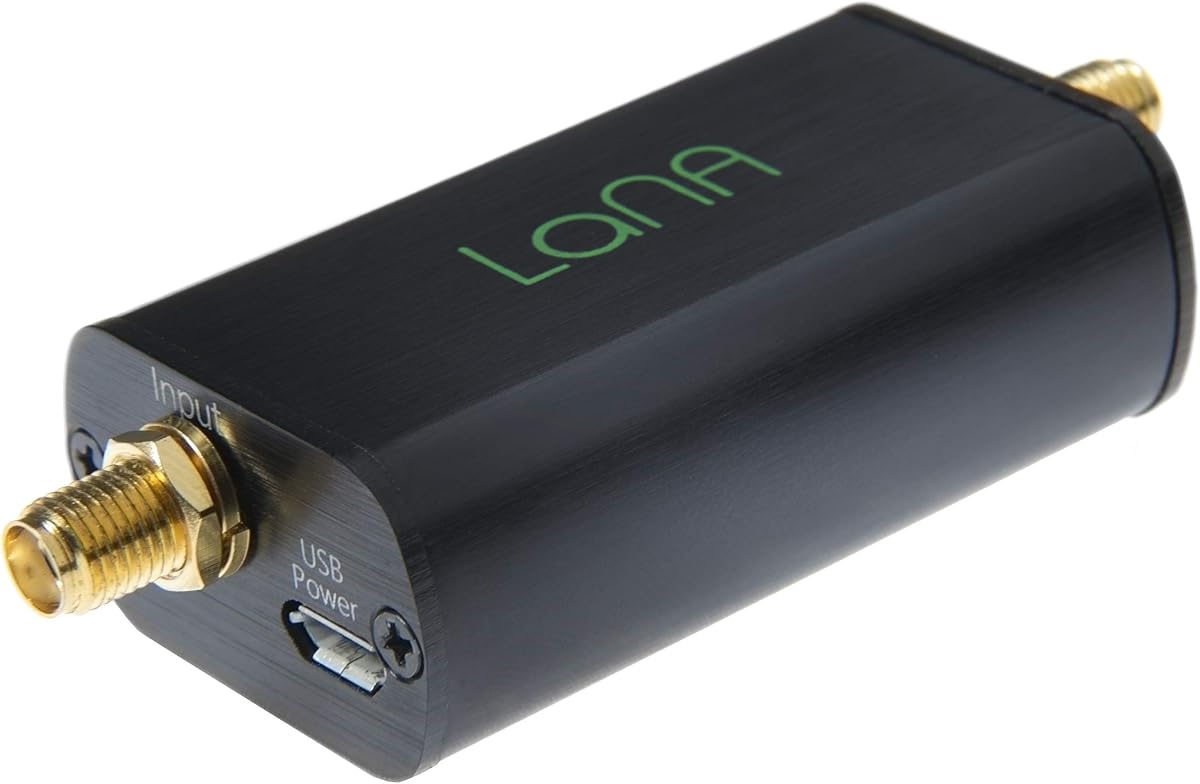
The Nooelec Lana improves SNR and performance for RTL-SDR SDR and other radios with its wideband 20MHz to 4GHz capability. Featuring an extremely low noise figure it outperforms modules based on SPF5189Z for better signal clarity.
We may earn a commission when you buy through this link, at no additional cost to you.
Power flexibility is a key advantage allowing operation via bias tee USB or DC power with included adapter. A free male SMA to male SMA connector simplifies integration into existing RF chains without extra purchases.
Higher gain lower power consumption and better linearity make it a superior general-purpose module. Users should note some SDRs require a DC block between the LNA and receiver when using external power options.
For SDR enthusiasts needing reliable wideband amplification with minimal noise this module delivers consistent high-quality results. Its quality build and versatile power options make it a solid choice for improving reception significantly.
Extremely low noise figure improves SNR and performance for RTL-SDR SDR and other radios effectively.
Powered via bias tee USB or DC power with included adapter for adaptable installation in various setups.
We may earn a commission when you buy through this link, at no additional cost to you.
This Generic Taurus MK2 Pre Amplifier is designed as a new wideband scanner amplifier covering 25 to 2000MHz. With 6 to 20dB gain it enhances weak signals for scanner receivers improving reception clarity without complexity.
We may earn a commission when you buy through this link, at no additional cost to you.
Powered by a standard PP3 battery it offers straightforward portability without needing external adapters. The package includes a BNC patch lead simplifying connection to compatible scanner systems immediately.
Its simplicity makes it ideal for hobbyists scanning police fire or aviation bands in local areas. While not suitable for high-performance SDR or amateur transceiver setups it serves basic scanning needs well.
For those seeking a budget-friendly booster specifically for scanners this amplifier provides reliable gain and easy setup. Its compact design and battery operation make it convenient for mobile or temporary scanning stations.
25 to 2000MHz range tailored for scanner receivers enhancing weak signal reception effectively.
PP3 battery operation ensures portability without needing external adapters or wall outlets.
We may earn a commission when you buy through this link, at no additional cost to you.
The BJ-300 Plus delivers high-power performance with up to 150W SSB 120W AM and 100W FM output extending communication range for reliable long-distance operation. It supports AM FM SSB and CW modes for versatile ham radio use.
We may earn a commission when you buy through this link, at no additional cost to you.
Designed to work with HF transceivers requiring 3-5W input this amplifier provides significant boost. A high-efficiency cooling fan and large red aluminum heat sink ensure stable operation preventing overheating during extended sessions.
Electronic polarity reversal protection and dual 15A fuses safeguard the unit from incorrect power connections and surges. Simple controls and PL-259 connectors make installation straightforward for both new and experienced users.
For CB and ham operators needing a robust amplifier for long-distance transmission this unit offers reliable power output and safety features. Its design prioritizes durability and thermal management to protect internal components.
Delivers up to 150W SSB 120W AM and 100W FM output extending communication range significantly.
High-efficiency cooling fan and aluminum heat sink prevent overheating during extended use.
We may earn a commission when you buy through this link, at no additional cost to you.
The AURSINC ZK09-UM LNA Module offers an ultra-broadband 100kHz to 10GHz range with 21.5dB gain at 10MHz providing great noise-floor improvement. Its low-noise good flatness makes it ideal for replacing ADM-8095 modules.
We may earn a commission when you buy through this link, at no additional cost to you.
USB interface power with a supply current of 52mA simplifies integration. On-chip bias solutions allow adjusting the resistor to reduce working current for different usage scenarios enhancing flexibility.
Built-in high-PSRR LDO suppresses power-supply noise improving performance over regular USB powered LNAs. The compact shielded metal housing ensures durability though users should avoid excessive input power or damp environments.
For TinySA ULTRA users or SDR enthusiasts seeking affordable broadband amplification this module delivers consistent quality. Its simple design and noise performance make it an excellent choice for enhancing high-band receiving capabilities.
Built-in high-PSRR LDO suppresses power-supply noise improving noise-floor over regular USB powered LNAs.
Ideal external preamplifier for TinySA-ULTRA improving high-band receiving and measuring performance below 3.5GHz.
We may earn a commission when you buy through this link, at no additional cost to you.
This BJ-300 Plus amplifier supports AM FM SSB and CW modes delivering up to 150W SSB 120W AM and 100W FM output for reliable long-distance operation. Its design extends communication range for CB and ham radio users.
We may earn a commission when you buy through this link, at no additional cost to you.
High-efficiency cooling fan and red aluminum heat sink ensure stable operation preventing overheating during extended sessions. Electronic polarity reversal protection and dual 15A fuses protect against incorrect connections and surges.
Simple controls including power switch mode selector and power adjustment paired with PL-259 connectors simplify installation. The unit is compatible with HF transceivers requiring 3-5W or 2-10W input power.
For operators needing a straightforward durable amplifier for high-power transmission this model provides essential features without complexity. Its thermal safety measures and user-friendly design ensure worry-free operation across various modulation modes.
Electronic polarity reversal protection and dual 15A fuses safeguard amplifier from incorrect connections and surges.
Simple controls and PL-259 connectors make installation quick for both new and experienced users.
We may earn a commission when you buy through this link, at no additional cost to you.
The BJ-300 delivers up to 100W FM 120W AM and 150W SSB output supporting input power from 3-5W AM/FM and 2-10W SSB. It works with AM FM SSB and CW modes ideal for radio and HF transceiver applications.
We may earn a commission when you buy through this link, at no additional cost to you.
Dual power control features HI/LO switches to adjust output strength based on needs paired with ON/OFF and LED indicator. Built-in electronic switch and polarity inversion protection ensure stable safe operation.
Compact aluminum alloy heat sink construction provides efficient heat dissipation with standard antenna and transceiver ports for quick installation. The design prioritizes practicality for users needing reliable boost without extra complexity.
For HF transceiver operators needing dependable amplification across standard modulation modes this model offers solid performance. Its protective features and compact form make it suitable for both fixed and mobile station use.
HI/LO power selection switches adjust output strength based on operating needs for versatility.
Compact aluminum alloy heat sink ensures efficient heat dissipation for stable operation.
We may earn a commission when you buy through this link, at no additional cost to you.
Selecting the right amplifier requires understanding your operating frequencies power needs and intended use case. This guide outlines critical factors to ensure compatibility and performance.
Frequency range determines which signals your amplifier can boost effectively. For broad SDR or shortwave listening choose wideband models covering 1MHz to 6GHz or higher. HF transceivers often need specific HF band amplifiers.
Match the amplifier's coverage to your target bands to avoid inefficiency or signal loss. Confirm compatibility with your radio's operating frequencies before purchasing.
Gain measured in dB indicates signal amplification strength while noise figure reflects added interference. Higher gain improves weak signals but excessive noise degrades clarity. Aim for low noise figures below 3dB for optimal performance.
Prioritize units with balanced gain and noise specs suitable for your receiver type. Ensure the amplifier enhances SNR without introducing distortion.
Check voltage and current needs to ensure compatibility with your station or portable power sources. Some models need 12V wall adapters while others run on USB or batteries. Confirm plug types and connector sizes.
Select power options that match your use case whether field testing or home operation. Verify supply stability to prevent amplifier damage.
Most RF amplifiers use 50 ohm impedance for standard cabling and connectors. Mismatches cause signal reflections and power loss. Ensure your antenna and radio interface align with the amplifier's specs.
Confirm connectors like SMA or PL-259 match existing cables to minimize installation issues. Adapter usage may be required.
Linearity ensures clean amplified signals without spurious emissions or intermodulation products. High linearity is critical for legal and clear communications. Look for solid-state designs with good flatness across bands.
Prioritize units with low distortion ratings for reliable performance. Avoid amplifiers that introduce unwanted noise or harmonics.
Extended transmission generates heat affecting amplifier lifespan. Built-in fans or large heat sinks prevent overheating. Some models include thermal shutdown to protect internal components.
Ensure the unit has adequate cooling for your operational load. Monitor temperature during heavy use to avoid failure.
Common connectors include SMA PL-259 BNC depending on the device type. Ensure the amplifier matches your existing antenna and radio connectors. Adapters add cost and potential signal loss.
Choose models with connectors that simplify integration. Verify gender and size to ensure secure connections.
Field use requires compact lightweight designs with rugged casings. Home stations may prioritize size and cooling features. Aluminum enclosures shield against interference better than plastic.
Assess weight and dimensions against your needs. Robust build quality extends amplifier life.
Connect the amplifier between your antenna and radio ensuring all cables are properly seated. Verify power supply matches the amplifier's specifications before turning it on. Secure connections prevent signal loss.
Monitor temperature during extended use to avoid overheating. Allow ventilation around cooling fans or heat sinks. For outdoor setups shield the unit from direct moisture and dust to maintain performance.
Perform regular checks for cable wear and connector integrity. Replace any damaged components promptly to prevent signal degradation. Clean connectors with proper tools to ensure reliable contact.
Receiving LNAs enhance weak signals without high power while transmitting amplifiers boost output for long-distance communication. LNAs focus on low noise and sensitivity whereas transmit amps prioritize power handling and thermal management.
Most SDR amplifiers are designed for receive-only use and lack the power handling for transmission. Using them as transmitters may damage the device. Always verify power ratings before connecting to transmit modes.
Depends on the model; some run on USB or battery while others require fixed DC adapters. Check the amplifier's power specifications to ensure you have compatible supply for your station setup.
Avoid connecting high-power sources directly without attenuation or isolation. Ensure input levels match the amplifier's tolerance to prevent distortion or permanent damage. Consult documentation for safe operating limits.
Most amplifiers use SMA PL-259 or BNC connectors matching standard radio cables. Confirm connector types before purchase and use adapters only if necessary to maintain signal integrity.
Many compact models with low power consumption work well for mobile use. Ensure stable power supply and secure mounting to prevent vibration damage. Portable options often include battery or USB power.
The reviewed amplifiers offer diverse options for improving ham radio signal clarity across various bands and uses. Whether seeking affordable preamps or high-power linear boosters each model provides distinct advantages.
Prioritize frequency range gain and noise performance to match your operational needs. Safety features and thermal management ensure reliability during extended use for both portable and fixed setups.
Prices and availability fluctuate so verify current offers and compatibility before purchasing. Select the amplifier that aligns with your goals for enhanced communication performance today.