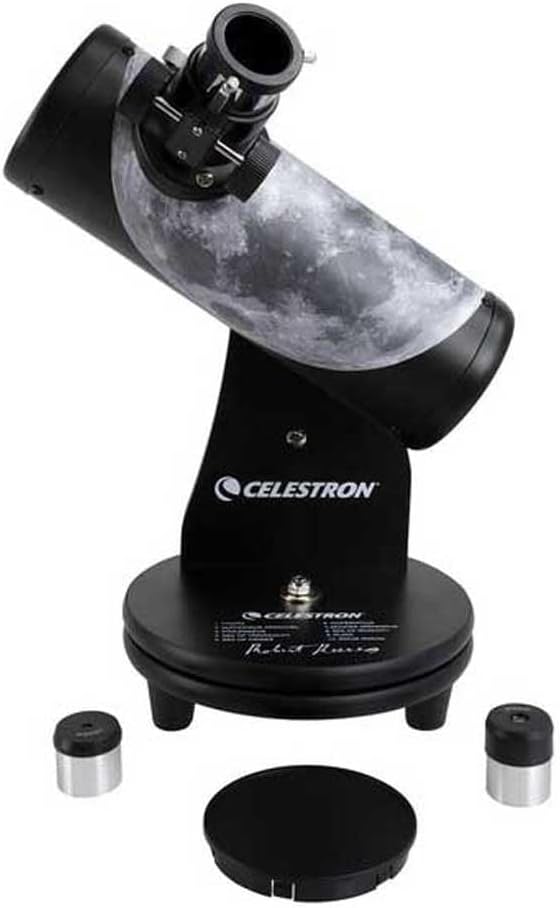
Celestron FirstScope Signature Series
4.3Editor score
Compact tabletop design
Easy for beginners
Affordable entry point
Dobsonian telescopes offer a simple and affordable way to explore the night sky. Their large apertures gather ample light to reveal deep-sky objects like galaxies and nebulae with stunning clarity for beginners and enthusiasts alike.
We evaluated ten leading models based on optical performance, build quality, and user experience. Our analysis considers aperture size, portability features, and included accessories to provide a comprehensive overview of the current market options available today.
Each selection highlights unique strengths ranging from tabletop convenience to advanced GoTo capabilities. While prices fluctuate over time, these picks represent the best value and performance you can find for exploring the cosmos with a Dobsonian design.
4.3Editor score

4.2Editor score

4.4Editor score
As an Amazon Associate we earn from qualifying purchases.
The following table provides a side-by-side overview of all ten models to help you compare key specifications and features at a glance for informed decision making.


The Sky-Watcher Heritage 150 stands out as a top choice for those seeking a balance between optical performance and portability. Its 150mm aperture provides crisp views of deep-sky objects while the collapsible design makes storage effortless for any home astronomer.
We may earn a commission when you buy through this link, at no additional cost to you.
Key strengths include the fast f/5 focal ratio which allows for bright images of nebulae and galaxies. The borosilicate parabolic primary mirror ensures minimal aberration. The rubber feet on the base minimize vibration for steady viewing sessions even on uneven surfaces.
While it lacks electronic features, the manual operation encourages learning the sky. The 1.25-inch focuser is smooth but requires care during transport. These trade-offs are acceptable given the price and performance ratio offered by this versatile instrument.
This telescope is ideal for beginners who want real power without the bulk of a large Dobsonian. It is also perfect for casual observers who value ease of transport. We highly recommend it for anyone ready to explore the night sky seriously.
The 150mm aperture paired with the f/5 focal ratio delivers bright and detailed views of planets and deep-sky targets that exceed expectations for this size class.
Its collapsible tube design and tabletop footprint make it exceptionally easy to store and transport without compromising on optical quality or stability.
We may earn a commission when you buy through this link, at no additional cost to you.
The Celestron StarSense Explorer 10 revolutionizes the classic Dobsonian design with smart technology that guides users to targets effortlessly. The 10-inch reflector gathers massive light while the app simplifies navigation for novices and experienced observers alike.
We may earn a commission when you buy through this link, at no additional cost to you.
The patented StarSense technology analyzes star patterns to pinpoint position without manual alignment. This means you spend less time hunting and more time viewing. The XLT coatings ensure sharp and vivid views of planets and galaxies even from city skies.
The dependency on a smartphone battery is a minor inconvenience but worth the ease of use. The price is higher than standard Dobsonians but justified by the advanced features and superior support included with the purchase. It offers a unique blend of simplicity and power.
Buy this if you want the largest aperture with the easiest setup experience available. It is perfect for families or groups where technology aids education. The robust warranty and support make it a reliable long-term investment in astronomy.
Using your phone as a celestial navigation system allows you to locate stars and nebulae instantly by following simple on-screen arrows.
The 254mm Newtonian reflector delivers impressive views of faint deep-sky objects like the Andromeda Galaxy with high clarity and brightness.
We may earn a commission when you buy through this link, at no additional cost to you.
The Celestron FirstScope Signature Series offers an entry point into astronomy that is hard to beat for price and portability. While designed with the Moon in mind it provides a solid foundation for learning how telescopes work without breaking the bank.
We may earn a commission when you buy through this link, at no additional cost to you.
Its compact tabletop design fits anywhere and requires no assembly. The build quality reflects Celestron's reputation for reliability even at this price point. It is an ideal gift for children or anyone wanting to try stargazing before committing to a larger instrument.
The smaller aperture limits deep-sky performance compared to larger models. However for lunar and planetary views it performs well. The trade-off is acceptable for beginners who prioritize budget and simplicity over maximizing light gathering power immediately.
This is the perfect choice for a first telescope or a travel scope. It encourages exploration without technical barriers. With the included warranty you can start your journey with confidence and upgrade later as your interests grow.
At a fraction of the cost of larger telescopes this model allows new users to experience clear views of the Moon and bright planets.
The tabletop design means you can set it up anywhere instantly making it perfect for spontaneous observing sessions at home or on trips.
We may earn a commission when you buy through this link, at no additional cost to you.
The Sky-Watcher Heritage 130 delivers full-sized optics in a remarkably compact package that requires no assembly upon arrival. Its 130mm aperture provides a significant step up in view quality for beginners seeking better performance on a budget.
We may earn a commission when you buy through this link, at no additional cost to you.
Included accessories like two eyepieces and a finderscope mean you can start observing immediately. The collapsible design keeps collimation intact while making transport easy. The RAQ coatings enhance image contrast for sharper planetary details than standard mirrors.
While the short focal length limits high magnification potential the overall value is exceptional. The tabletop design may wobble slightly in wind but this is manageable for casual use. It strikes a great balance between portability and optical capability for most users.
Choose this if you want a hassle-free experience with quality optics at a low price. It is perfect for home use or light travel. The two-year warranty adds peace of mind for those taking their first steps into serious astronomy.
This telescope comes fully assembled with all necessary accessories included so you can start observing stars right away without extra purchases.
The unique tube design allows for easy storage and transport while maintaining the optical alignment necessary for crisp clear images.
We may earn a commission when you buy through this link, at no additional cost to you.
The Sky-Watcher Classic 200 offers a classic 8-inch experience with a traditional solid tube design that prioritizes optical stability. Its large aperture reveals faint galaxies and star clusters that smaller scopes simply cannot show to the naked eye.
We may earn a commission when you buy through this link, at no additional cost to you.
Teflon bearings provide smooth movement for tracking objects across the sky. The included accessories such as wide-angle eyepieces and a finder scope add significant value. The tension control handles allow precise adjustments without needing perfect balance every time.
The solid tube is less portable than collapsible models making it better for fixed locations. The weight might be challenging for younger users. However for deep-sky enthusiasts who value aperture over mobility this model remains a strong traditional choice.
This is best for observers with a dedicated observing spot who want maximum light gathering. It is suitable for families willing to manage the extra weight. The robust construction ensures it will serve as a reliable tool for years of exploration.
The 8-inch mirror gathers enough light to reveal faint deep-sky objects and fine lunar details that are invisible to smaller telescopes.
Proprietary Teflon bearings ensure that moving the telescope to follow objects is fluid and effortless during your observing sessions.
We may earn a commission when you buy through this link, at no additional cost to you.
The Celestron StarSense Explorer LT brings smart technology to a budget-friendly package that simplifies finding targets for new astronomers. It uses the same StarSense app as larger models to guide you to the night sky's best objects instantly.
We may earn a commission when you buy through this link, at no additional cost to you.
The 114mm Newtonian reflector provides decent views of planets and bright nebulae. The altitude slow motion adjustment helps keep targets centered in the eyepiece during manual tracking. This combination of guidance and optical clarity makes learning astronomy enjoyable.
The mount is less robust than premium versions which can lead to slight vibration. The aperture limits deep-sky capability compared to larger options. These compromises are acceptable given the low price and the convenience of the smartphone integration provided.
This model is perfect for urban observers or beginners who prioritize ease of use. It removes the intimidation of star charts and complex alignments. For anyone wanting to learn the constellations and planets quickly this is a practical and affordable tool.
The StarSense app uses your phone to analyze star patterns and point you to targets automatically without manual alignment.
The altitude slow motion rod allows you to keep planets and stars centered in the view for a longer period without jitter.
We may earn a commission when you buy through this link, at no additional cost to you.
The Celestron FirstScope Signature series is designed specifically for those who want to enjoy the Moon and bright planets without complexity. It serves as an excellent introduction to optical astronomy with a focus on simplicity and durability for daily use.
We may earn a commission when you buy through this link, at no additional cost to you.
Its tabletop design means it is always ready for a quick look at the sky. The build quality is solid enough for outdoor use without worry. It is often recommended for children or casual users who do not need deep-sky power.
The limited aperture restricts its use for faint objects but that is not its primary goal. The stability is good for a small scope though wind can affect it. This trade-off is acceptable for the target audience who values portability over deep-sky capability.
This is the ideal first instrument for a child or a casual observer. It removes the barrier of expensive gear and complex setup. With a solid warranty backing it provides a safe and reliable way to begin exploring the night sky.
This scope is optimized for showing the craters and surface details of the Moon with clarity and ease of setup for all ages.
The compact design allows it to be stored easily and the durable construction ensures it survives the occasional bump or drop.
We may earn a commission when you buy through this link, at no additional cost to you.
The Sky-Watcher Flextube 200 combines the light gathering power of an 8-inch reflector with a portable collapsible design. This makes it easier to transport to dark sky sites compared to traditional solid tube Dobsonians of the same size.
We may earn a commission when you buy through this link, at no additional cost to you.
The unique strut system collapses the optical tube for storage while keeping collimation stable. Teflon bearings ensure smooth movement for tracking targets. The included accessories like wide-angle eyepieces make this a complete observing package for enthusiasts.
Setting up the collapsible tube takes more time than solid models which can be a minor drawback. The weight is still significant for a transportable design. However the benefit of 8-inch power in a travel-friendly package makes these compromises worthwhile for many.
This is best for astronomers who want to observe from dark locations without a permanent mount. It offers a great balance of power and portability. The sturdy design ensures it remains reliable even after repeated setup and takedown cycles in the field.
The unique strut design allows the tube to collapse for easy transport while maintaining precise optical alignment for clear views.
With included eyepieces and finder scopes you have everything needed to start observing deep-sky objects right out of the box.
We may earn a commission when you buy through this link, at no additional cost to you.
The Sky-Watcher Virtuoso GTI 150P blends tabletop convenience with advanced GoTo technology that automates object tracking. Its 150mm aperture provides bright views while the built-in Wi-Fi connects directly to your phone for easy control.
We may earn a commission when you buy through this link, at no additional cost to you.
Freedom Find technology allows manual movement while retaining alignment which is useful if you want to explore freely. The collapsible tube adds portability to an otherwise heavy computerized mount. This creates a unique hybrid between traditional Dobsonians and robotic scopes.
The setup is more complex than a manual Dobsonian and requires a power source. You must rely on the battery for operation which can be a constraint. However the convenience of automated tracking and a vast object database makes this a powerful tool for busy observers.
This model is perfect for those who want automation without sacrificing optical power. It fits well for urban astronomers who have limited setup time. The combination of portability and intelligent tracking makes it a standout option in the crowded telescope market.
The built-in Wi-Fi allows you to use your phone to select targets and have the scope point to them automatically.
Patented dual encoders allow you to move the telescope manually without losing alignment for a more flexible experience.
We may earn a commission when you buy through this link, at no additional cost to you.
The Celestron NexStar 8SE is a versatile computerized telescope that offers precision and ease for serious observers. While not a Dobsonian it provides comparable aperture with automated tracking that simplifies the observing experience significantly.
We may earn a commission when you buy through this link, at no additional cost to you.
The 8-inch Schmidt-Cassegrain optics deliver fine details on planets and galaxies. The NexStar+ hand control offers a massive database of objects for selection. SkyAlign technology aligns the mount quickly using bright stars you know without needing a full star chart.
The price is higher than manual Dobsonians but the computerization adds significant convenience. The tube is compact but the mount adds bulk to transport. These trade-offs are acceptable for those who want automated precision and a broad object database without manual searching.
This is ideal for users who want maximum automation with high optical performance. It suits those who want to observe efficiently without spending time on star alignment. The reliability and support make it a solid long-term investment for advanced stargazing.
The fully computerized mount handles slewing and tracking so you can focus on viewing rather than manual pointing.
Access to over 40,000 objects in the hand control database ensures you never run out of targets to explore and study.
We may earn a commission when you buy through this link, at no additional cost to you.
Choosing a Dobsonian telescope involves balancing aperture, portability, and budget. This section breaks down the key factors to help you make an informed decision for your specific observing needs.
Aperture refers to the diameter of the primary mirror and determines how much light the telescope gathers. Larger apertures reveal fainter objects like distant galaxies and nebulae but require a larger tube and mount.
For beginners a 130mm to 150mm aperture offers a great balance. If you plan to observe from dark skies frequently consider 8 inches for maximum light gathering power.
Portable models often feature collapsible tubes or tabletop designs that fit in smaller vehicles or storage spaces. Traditional solid tubes provide stability but are harder to transport regularly to observing sites.
If you need to move your scope often look for models with innovative collapsible designs. These maintain collimation while significantly reducing storage length and weight.
High-quality mirrors with coatings like Borosilicate or Aluminum Quartz enhance contrast and reduce aberration. A parabolic primary mirror ensures sharp focus across the field of view.
Check for specifications on coatings and mirror type to ensure you get crisp images. Avoid cheap optics that may degrade image quality even if the aperture is large.
A good telescope should come with eyepieces and a finderscope to start observing immediately. Look for sets that include at least two focal lengths for versatile viewing.
Additional accessories like star pointers or carrying cases add value. Ensure the included accessories match your needs before purchasing to avoid extra costs later.
For beginners simplicity is key. Models with intuitive mounts and straightforward setup processes reduce frustration and encourage frequent observation.
Consider if you want manual control or automated features. Simple Dobsonians are often easier for learning basic navigation while automated scopes help with target location.
A sturdy base prevents shaking that can blur images. Teflon bearings and rubber feet improve stability and smoothness of movement.
Check the weight and footprint of the base. A heavier base often means better stability but harder transport. Ensure it suits your observing environment.
Newer models offer app integration for guided tours and star recognition. This can significantly ease the learning curve for new astronomers.
These features require a smartphone and battery power. Consider if you prefer tech assistance or traditional manual navigation.
A reliable warranty protects your investment against defects. Look for brands that offer at least a two-year warranty.
Check if customer support is accessible via phone or email. Good support ensures you get help if you encounter issues with your telescope.
To start observing simply unfold the mount and ensure the optical tube is secure. Point the telescope roughly at a bright object like the Moon to practice aiming. The altazimuth movement allows easy up-down and left-right adjustments.
Collimate your mirrors periodically if you notice distorted stars. Use the adjustment screws on the secondary mirror to center the light path. This ensures the best possible image quality for your viewing sessions.
Store your telescope in a dry place to protect the optics from moisture and dust. Use protective covers when not in use. Clean the mirrors only if necessary using a soft brush to avoid scratches.
Yes, Dobsonians are ideal for beginners due to their simplicity and large aperture at a low cost. They allow new users to see deep-sky objects without complex assembly. The manual operation also helps learn the night sky faster.
You can see the Moon, planets like Jupiter and Saturn, star clusters, nebulae, and galaxies. Larger apertures reveal fainter objects like the Andromeda Galaxy clearly. It is versatile for both planetary and deep-sky viewing.
Not necessarily. Manual Dobsonians are easier to use for learning and often cheaper. Computerized models add convenience for locating targets but cost more. Choose based on your budget and desire for automation.
Many models are portable tabletop designs that fit in car trunks. Larger models may require disassembly of the tube and base. Check the dimensions and weight before purchasing to ensure easy transport.
An 8-inch collapsible Dobsonian is often best for dark skies due to its large light gathering power. It reveals faint objects well while remaining transportable. Look for high-quality optics to maximize the dark sky experience.
Most include at least two eyepieces to provide different magnifications. Check the product details to confirm. Some may require purchasing additional eyepieces for specific viewing needs.
Yes, modern models offer smartphone integration for guided tours. Apps can locate targets automatically using camera sensors. This makes finding objects easier for those new to astronomy.
We have reviewed ten outstanding models ranging from compact tabletop units to powerful 8-inch giants. Each offers unique benefits to suit different budgets and experience levels.
Prioritize aperture if you want deep-sky views and portability if you travel often. Consider smart features if you want easier navigation without manual star charts.
Prices may change over time so check current listings before purchasing. Selecting the right telescope ensures countless nights of clear skies and stunning views.