
Sntieecr STEM Electric Circuit Motor Kit
4.2Editor score
Includes motors and bulbs
Simple circuit assembly
Affordable educational tool
This guide compares the top electricity learning kits for students and beginners, focusing on project variety, safety features, and educational value.
Electricity learning kits provide an interactive way for students to understand the fundamental principles of circuits and energy. These hands-on tools transform abstract concepts into tangible experiences, making complex physics accessible to young minds. Whether for home schooling or classroom use, the right kit fosters curiosity and critical thinking skills effectively.
To compile this list, we evaluated numerous products based on component quality, instructional clarity, and the breadth of experiments offered. We prioritized kits that encourage exploration beyond simple assembly, ensuring learners grasp the why behind the how. Safety certifications and durability were also key factors in our selection process for reliability.
Each pick below highlights specific strengths such as project count, age appropriateness, and included accessories. We have verified ratings and specifications to ensure accuracy for your decision-making. Please note that product availability and pricing may fluctuate over time, so checking current listings is recommended before purchase.
4.2Editor score

4.7Editor score

4.5Editor score
The following table provides a side-by-side comparison of all ten selected kits to help you identify the best fit for your educational needs.



This National Geographic kit stands out as the top choice for families seeking a comprehensive introduction to electrical engineering. With over 120 projects, it offers endless opportunities for exploration without becoming repetitive. The high user rating reflects consistent satisfaction among parents and educators alike regarding its quality and engagement level.
We may earn a commission when you buy through this link, at no additional cost to you.
The standout feature is the ease of use combined with educational depth. Components snap together securely, eliminating the need for soldering or complex tools that might frustrate younger learners. Video instructions accessible via QR codes ensure that help is always at hand, making independent learning truly feasible for children.
While the price is higher than basic sets, the longevity and variety justify the investment. Some users note that batteries are not included, which is a minor inconvenience but standard for most kits of this caliber. The safe design ensures that curiosity can be pursued without unnecessary risks of injury or damage.
This kit is ideal for children aged eight and up who have a genuine interest in how things work. It serves equally well for home schooling curriculums or weekend hobby projects. If you want a set that grows with your child and keeps them engaged for hours, this is the definitive recommendation.
From building sound systems to creating light shows, the sheer number of unique configurations prevents boredom and encourages repeated play.
Components connect easily without tools, ensuring a frustration-free experience that keeps focus on learning concepts rather than assembly struggles.
We may earn a commission when you buy through this link, at no additional cost to you.
This EUDAX kit is designed specifically for high school students who need to bridge the gap between textbook theory and practical application. It covers both electricity and magnetism comprehensively, offering a more complete physics education than standard introductory sets. The components are robust enough to withstand rigorous experimentation by older students.
We may earn a commission when you buy through this link, at no additional cost to you.
The manual is particularly impressive, providing full-color diagrams and detailed explanations that support deep understanding. Projects like measuring unknown resistors with Ohm's law or investigating Ampere's force move beyond simple light bulb circuits. This depth ensures students are prepared for more advanced academic challenges in STEM fields.
One trade-off is the requirement for batteries which are not included, meaning users need to source these separately to get started. Additionally, the complexity might be overwhelming for younger children compared to simpler snap kits. However, for the target age group, this level of detail is exactly what is needed for success.
Parents and teachers looking for a serious educational tool will find immense value here. It effectively simulates a real physics lab environment within the home or classroom. If your student is ready to move past basic circuits into electromagnetism, this kit provides the perfect foundation and range of tools.
The inclusion of magnetism experiments alongside electricity provides a holistic view of electromagnetic theory essential for high school physics.
Repair tools and durable storage ensure the kit remains functional over years of use, making it a cost-effective long term investment.
We may earn a commission when you buy through this link, at no additional cost to you.
The Sntieecr motor kit offers an incredibly accessible entry point for families wanting to explore electricity without a significant financial commitment. It includes motors, bulbs, and clips, allowing for a variety of basic circuit experiments. Despite the low price, the educational value remains high for introducing core concepts.
We may earn a commission when you buy through this link, at no additional cost to you.
This kit excels in simplicity and clarity of design. The crocodile clips make connections straightforward, while the included motors add an interactive dynamic that lights alone cannot provide. It serves as an excellent supplement to classroom learning or a first step for curious kids interested in STEM.
Users should be mindful of the voltage limitations to prevent overheating, as the instructions advise keeping usage under a few minutes at higher voltages. While the price is a major benefit, the components are not as durable as premium sets, which might limit long-term heavy use without careful handling.
For those on a tight budget or looking to test a child's interest before investing more, this is the ideal choice. It provides enough functionality to demonstrate series and parallel circuits effectively. We recommend it for casual experimentation and introductory science projects in a home setting.
With all essential components included at a low cost, it removes barriers for families wanting to try science experiments at home.
The inclusion of motors allows children to see electrical energy converted into mechanical motion, enhancing understanding of energy transformation.
We may earn a commission when you buy through this link, at no additional cost to you.
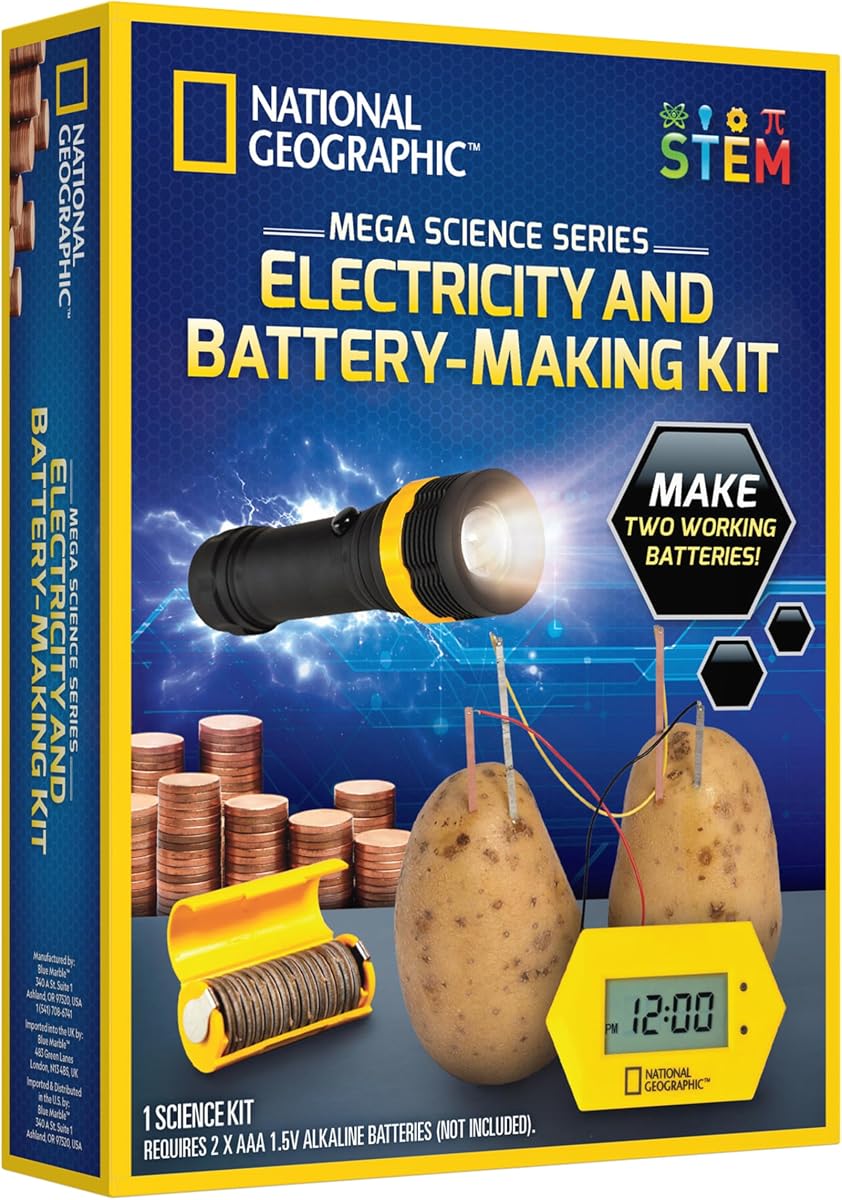
This specialized kit focuses on the science of batteries, offering two distinct projects that are both fun and educational. The potato clock experiment is a classic that vividly demonstrates how chemical energy can be converted into electrical current. It is a unique niche product that complements broader circuit kits well.
We may earn a commission when you buy through this link, at no additional cost to you.
The design of the kit encourages immediate engagement with minimal setup. Children can build a functional clock using household produce, which creates a memorable learning experience. The inclusion of a voltmeter helps visualize the electrical output, adding a layer of quantitative analysis to the activity.
While the limited number of projects might seem restrictive compared to larger sets, the depth of learning regarding energy sources is significant. It is not intended as a comprehensive circuit building tool but rather as a focused study on power generation. This distinction makes it a valuable addition to any science collection.
We recommend this for younger learners or as a supplementary activity to a larger kit. It is perfect for science fairs or specific lessons on energy. If your goal is to show children how batteries work in a tangible way, this kit delivers exactly that with excellent guidance.
The potato clock provides a safe and visible way to understand electrochemical reactions without needing complex equipment or chemicals.
Simple instructions allow kids to start building immediately, fostering a sense of accomplishment and curiosity about everyday science.
We may earn a commission when you buy through this link, at no additional cost to you.
This kit strikes a balance between simplicity and educational depth, making it suitable for a wide age range from eight to fourteen. It emphasizes fruit energy projects which are highly engaging and memorable for kids. The eight experiments cover essential concepts like series and parallel circuits effectively.
We may earn a commission when you buy through this link, at no additional cost to you.
The accompanying circuit book serves as a valuable reference, guiding learners through each step with clear instructions. This structure helps prevent confusion and ensures that children understand the theory behind each experiment. It is an excellent tool for fostering critical thinking and problem-solving skills in a structured environment.
One limitation is that it focuses heavily on basic circuits and may not offer the advanced magnetic components found in more expensive sets. However, for introducing the core principles of electricity and conductivity, it is highly effective. The projects are designed to be safe and easy to manage at home.
For parents looking for a middle-ground option that is more than a toy but less complex than a physics lab, this is ideal. It works well for school science fairs or general STEM enrichment. If you want to teach electrical engineering basics with fun food-based experiments, this kit is a strong choice.
The included book ensures that every experiment builds on the previous one, creating a coherent learning journey for young students.
Creating batteries from fruits makes abstract concepts like voltage and current concrete and relatable for young learners.
We may earn a commission when you buy through this link, at no additional cost to you.
The Teenii kit is explicitly designed to encourage family participation, making science a shared activity rather than a solitary task. It includes a robust set of fifty pieces and eighteen distinct experiments that cover both electricity and magnetism. This broad scope allows for varied play and learning sessions.
We may earn a commission when you buy through this link, at no additional cost to you.
Components like the voltmeter, fan, and motor add realism to the experiments, making them feel more like professional physics tools. The manual is detailed enough to guide beginners but simple enough to keep the focus on discovery. It is an excellent choice for fostering curiosity and observation skills.
While the manual is comprehensive, some users find the setup for each experiment slightly involved. However, this effort often leads to deeper learning as children engage more with the assembly process. The materials are durable and designed to withstand regular use by children aged eight and older.
We recommend this for families who want to bond over educational projects. It is versatile enough for classroom use or home schooling activities. If you value collaborative learning and want a kit that supports a wide range of experiments, this set provides great value and satisfaction.
Designed for parent-child interaction, it strengthens family bonds while teaching critical scientific concepts together.
With fifty pieces including measuring tools, it offers a realistic science lab experience for home use.
We may earn a commission when you buy through this link, at no additional cost to you.
Mysterystone positions itself as a true physics lab starter, offering a mix of electricity and magnetism experiments that mirror school curriculums. The fifty experiments and fifty-five components provide a rich environment for learning. Unique items like the Joule law module add a layer of scientific depth not found in toys.
We may earn a commission when you buy through this link, at no additional cost to you.
The manual is well-written, explaining not just the how but also the why of each experiment. This educational approach helps students internalize concepts rather than just following instructions blindly. The storage case keeps all parts organized, which is crucial for maintaining the longevity of the kit.
One consideration is that the projects require focus and attention to detail, which might challenge very young children. However, for students ready to engage with real physics concepts, this is highly beneficial. The durability of the case ensures that the kit can be used repeatedly without losing parts.
For students seeking to understand the mechanics of circuits and magnetism deeply, this is an excellent investment. It is suitable for independent study or guided family projects. If you want a kit that treats science seriously while remaining accessible, this one delivers on its educational promise.
The manual explains the theory behind experiments, ensuring students understand the principles of physics rather than just assembling parts.
Every item has a fixed place in the case, making cleanup easy and ensuring all components remain safe for future use.
We may earn a commission when you buy through this link, at no additional cost to you.
This kit is a robust option for high school students needing a serious introduction to electromagnetism. It includes fifty-five items for electricity and twenty-two for magnetism, allowing for a wide range of complex experiments. The manual provides operation steps and equipment lists for each experiment to guide users accurately.
We may earn a commission when you buy through this link, at no additional cost to you.
Unique features like a sensitive ammeter and a magnetically controlled switch elevate the learning experience beyond standard kits. These components allow for precise measurements and advanced demonstrations that align well with academic requirements. The storage box is sturdy and keeps everything organized for easy transport.
The learning curve is steeper compared to simpler sets, but this is intentional to match the educational level. It is designed to deepen understanding of concepts learned in class rather than just repeating them. The durability of the storage box ensures the kit can be carried between home and school easily.
We recommend this for students who want a reliable tool for homework and independent study. It is also great for science clubs looking for challenging projects. If you need a kit that bridges the gap between basic toys and professional lab equipment, this is a top contender.
Inclusion of sensitive ammeters and unique switches allows for precise experiments that teach measurement and control in circuits.
The double-layer storage box makes it easy to transport the kit to friends houses or school, encouraging social learning.
We may earn a commission when you buy through this link, at no additional cost to you.
This basic kit is specifically tailored to help students consolidate knowledge gained from textbooks. It focuses on the essential series and parallel circuits that form the foundation of electrical understanding. The clear English instructions make it accessible for a wide audience without language barriers.
We may earn a commission when you buy through this link, at no additional cost to you.
The plastic storage box ensures that all accessories are kept together, which is vital for maintaining a functional kit over time. While it is an introductory tool, it effectively bridges the gap between theory and practice. It is particularly useful for summer camps or home school unit studies.
One minor drawback is the lack of included batteries, meaning users must purchase these separately before starting. However, this is common in educational kits to allow for battery selection. The safety focus and durability make it a trusted choice for schools and parents alike.
For junior high students beginning their physics journey, this is a reliable and cost-effective choice. It provides a safe environment to test ideas and understand basic rules. If you are looking for a kit that supports classroom learning with practical applications, this is a strong option.
Designed to reinforce school curriculum, it helps students visualize concepts taught in class through hands-on practice.
The focus on basic circuits ensures safety while building a solid foundation for future advanced learning in electronics.
We may earn a commission when you buy through this link, at no additional cost to you.
This upgrade version offers a broader range of projects including traffic lights and wind power cars, making it ideal for engaging students. The transparent storage box allows for quick visual checks of inventory, which is helpful for classroom management. The manual explains why experiments work, not just how to set them up.
We may earn a commission when you buy through this link, at no additional cost to you.
It covers grades seven to eleven, providing a versatile tool for different age groups within a school setting. The inclusion of switches, wires, and LEDs ensures that students can build a variety of models without needing extra parts. It is designed to be ready right out of the box for easy setup.
While it shares many components with the basic version, the upgraded project list adds more complex scenarios for students to solve. This keeps the learning experience fresh and exciting. The focus on explaining principles helps teachers guide discussions and deepen student understanding during lessons.
For educators looking for a classroom-ready kit, this provides the structure and variety needed for effective teaching. It is also suitable for serious home enthusiasts. If you want a kit that supports both instruction and creative exploration, this upgrade version meets those needs effectively.
Designed with classroom needs in mind, the transparent box and comprehensive projects help streamline the teaching process.
Adding traffic lights and wind cars expands the scope of experiments to include real world applications of electrical power.
We may earn a commission when you buy through this link, at no additional cost to you.
Selecting the right kit depends on age, budget, and educational goals. Here are key factors to consider.
The age range is critical because kits vary from simple snap connections to complex wiring. Younger children need kits with large parts and minimal tools to ensure safety. Older students benefit from kits that include tools like ammeters and soldering options.
Always check the manufacturer's age recommendations to match the kit with your child's skill level.
A good kit should offer enough unique projects to prevent boredom. Look for sets that include series circuits, parallel circuits, and creative applications like light shows. A high project count often indicates better value over time.
Variety ensures sustained engagement and allows learners to explore different aspects of electrical science.
Manuals play a huge role in learning outcomes. Some kits focus on assembly, while others explain the theory behind the circuits. For academic success, choose kits that explain the why and not just the how.
Deep educational content helps students retain knowledge and apply it to new problems.
Durable parts withstand repeated use and reduce frustration from broken wires or connectors. Check for reviews that mention durability and the robustness of the storage solution. Higher quality components often lead to better performance during experiments.
Quality materials ensure the kit lasts longer and remains safe to use over time.
Safety is paramount when working with electricity. Look for kits that explicitly mention safety certifications and low voltage limits. Avoid kits with small parts for younger children to prevent choking hazards.
Ensuring safety features are present protects children from burns or electrical shocks.
Clear instructions are essential for independent learning. Kits with step-by-step guides or video support are easier to use. If the manual is vague, the experience can become frustrating quickly.
Good instructions empower learners to succeed without constant adult intervention.
Most kits require batteries that are not included. Be aware of the type and quantity needed to avoid surprise costs. Some kits are designed for rechargeable batteries while others use standard alkaline ones.
Knowing battery requirements helps you budget and get started immediately.
Organized storage keeps parts from getting lost. Kits with sturdy cases or compartments are easier to maintain. A good storage solution also makes cleanup after play much simpler for parents.
Proper storage extends the life of the kit by keeping all parts together and safe.
Start by reading the entire manual before building any circuits to understand the safety precautions and component functions. This preparation helps prevent mistakes and ensures you know how to handle sensitive parts correctly.
Always disconnect power when modifying a circuit to avoid short circuits or overheating. Keep batteries fresh and remove them if the kit is not in use for long periods to prevent leakage.
Store all components in their designated storage case after each session. Regularly inspect wires and connectors for damage to ensure safe operation during future experiments.
Most kits are designed with safety in mind, using low voltage that does not pose a shock risk. However, small parts can be a choking hazard for toddlers, so always check the age recommendations. Supervision is recommended for children under eight to ensure proper handling of batteries and components.
Many kits are tool-free and use snap connections for easy assembly. However, some advanced kits may require basic tools like wire strippers or screwdrivers. Always check the product details to see if tools are included or must be purchased separately.
Most kits use standard AA batteries, though some may require D or C cells. It is common for batteries not to be included, so you may need to purchase them separately. Check the specific requirements for each kit to ensure you have the correct power source.
Yes, these kits are excellent for school science projects as they provide hands-on experience with circuits. Teachers often use them for classroom demonstrations or student competitions. The included manuals usually provide enough detail to meet educational standards.
Durability varies by brand, but high-quality kits can last for years with proper care. Wires and connectors are the most common parts to wear out. Keeping parts in the storage case and avoiding physical stress helps extend the lifespan of the components.
Beyond the initial purchase and batteries, there are usually no hidden costs. However, you may want to buy extra wires or accessories for custom projects. Some brands offer expansion packs that can add to the base kit later.
In conclusion, the National Geographic Circuit Kit stands out as the top choice for overall value and variety. It offers the most comprehensive experience for families seeking an engaging educational tool. For high school students, the EUDAX physics lab provides the depth needed for academic success.
When prioritizing, consider your child's age and their interest level in science. A simple kit is perfect for curiosity while complex sets suit those aiming for engineering careers. The right choice balances fun with educational rigor to keep learning enjoyable.
Remember that prices and availability may change, so reviewing current listings is wise before buying. We hope this guide helps you select a kit that sparks a lifelong interest in electricity and science. Happy experimenting!